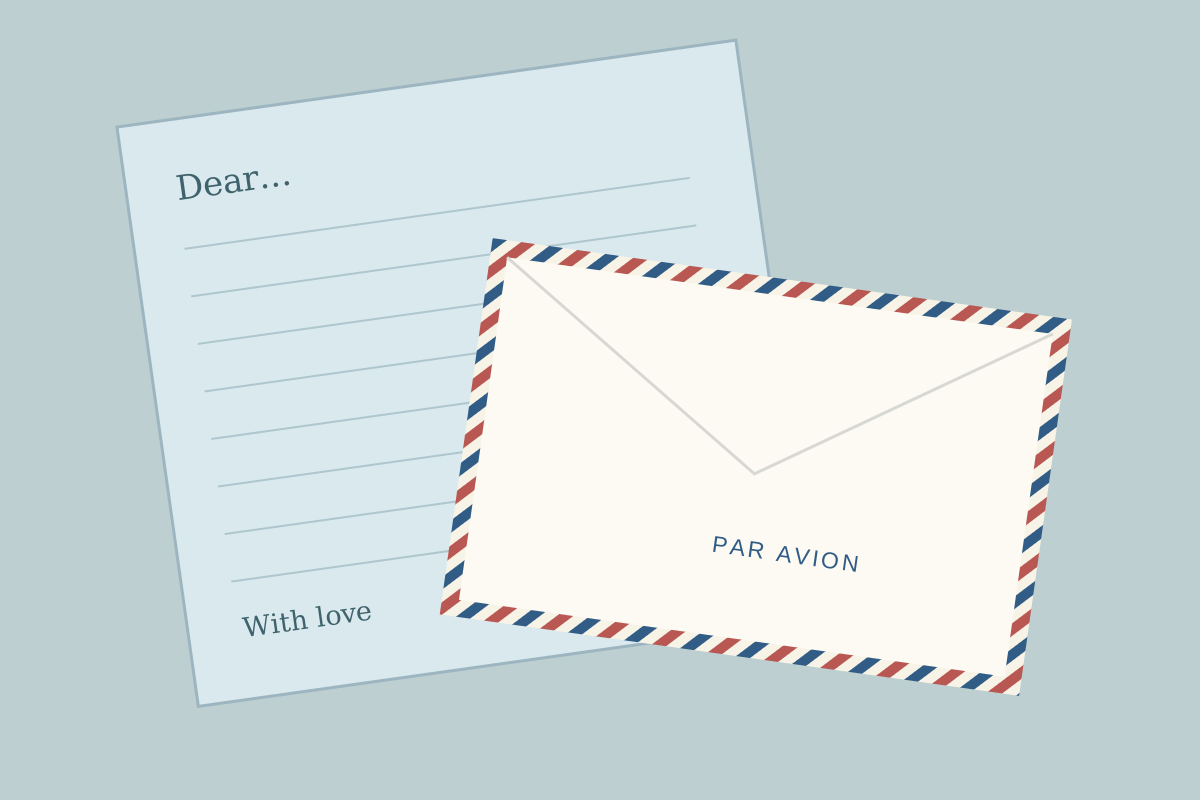
People in the Netherlands with family or friends abroad knew the ritual. You took a sheet of airmail paper, found a pen that would not show through too much, and began at the top: ‘Dear…’ The paper felt different from an ordinary writing pad. Light, smooth and sometimes almost translucent. You wrote carefully, because a crumpled sheet was not easily smoothed out again.
An address book and an airmail envelope might already be on the table. Along the edge ran the familiar pattern of red and blue diagonal stripes. On the front it said Par avion or By airmail. Those words alone made the distance visible: this letter had to catch a plane.
Why so thin?
For international post, weight mattered. Air transport was more expensive than carriage by land or sea, especially when flying was less commonplace. Thin paper kept a letter light. More correspondence could therefore fit into the same weight band. An extra sheet, photograph or cutting might mean paying more postage.
There was also a special variation: the air letter, or aerogramme. It served as both writing paper and envelope. You wrote on the designated sections, folded the sheet along the lines and sealed the edges. No separate envelope was needed. Some had postage already printed on them; others needed stamps. In the Netherlands, these air letters were available at least in the 1950s and still in the 1990s.
A letter on loose airmail paper was therefore different from such a folding sheet. But both had the same aim: sending many words with as little weight as possible.
Using every inch
Anyone using just one sheet learned to write small. The first lines covered the weather, work and health. Then came the things that mattered more: a new job, a birthday you had missed, a child who could suddenly walk. The margins narrowed as the story progressed. At the bottom there might be a hurried ‘P.S.’, followed by another.
An airmail letter often accumulated over several days. ‘I will continue tomorrow’, it said halfway through. A new date and paragraph followed. By the time it finally went in the post, the first news was already a week old. That did not matter. The recipient received not just information, but a glimpse of the other person’s everyday life.
A fountain pen required care. On very thin paper, ink could spread or show through the back. A ballpoint was often easier, provided you did not press so hard that the next page picked up an impression of the letters.
The journey began at the postbox
Then came the practical part. The address had to be correct, especially the postcode, town and country. You could weigh the letter or ask at the post office counter how many stamps it needed. The envelope disappeared into the postbox, and from that moment you could do little but wait.
Waiting was part of the correspondence. A reply might take days or weeks, depending on the destination, connections and postal delivery. You often recognised the handwriting on the doormat before reading the sender’s name. Sometimes there was a foreign stamp you wanted to carefully save. Perhaps you checked the postmark date first. Only then did you tear open the edge.
A thin sheet with great meaning
The telephone existed too, of course, but calling abroad was not an obvious way to catch up for everyone. A letter gave you time to think and room to say something you might not mention on the phone. You could also reread it, show it to others or keep it in a box among other letters.
Today, a message can travel around the world in seconds. Yet airmail paper is more than a symbol of slow communication. It also recalls the care with which someone sat down, filled a sheet and addressed it to one person. Years later, that wafer-thin paper could still convey exactly how far away someone once was — and how briefly a letter brought them close.