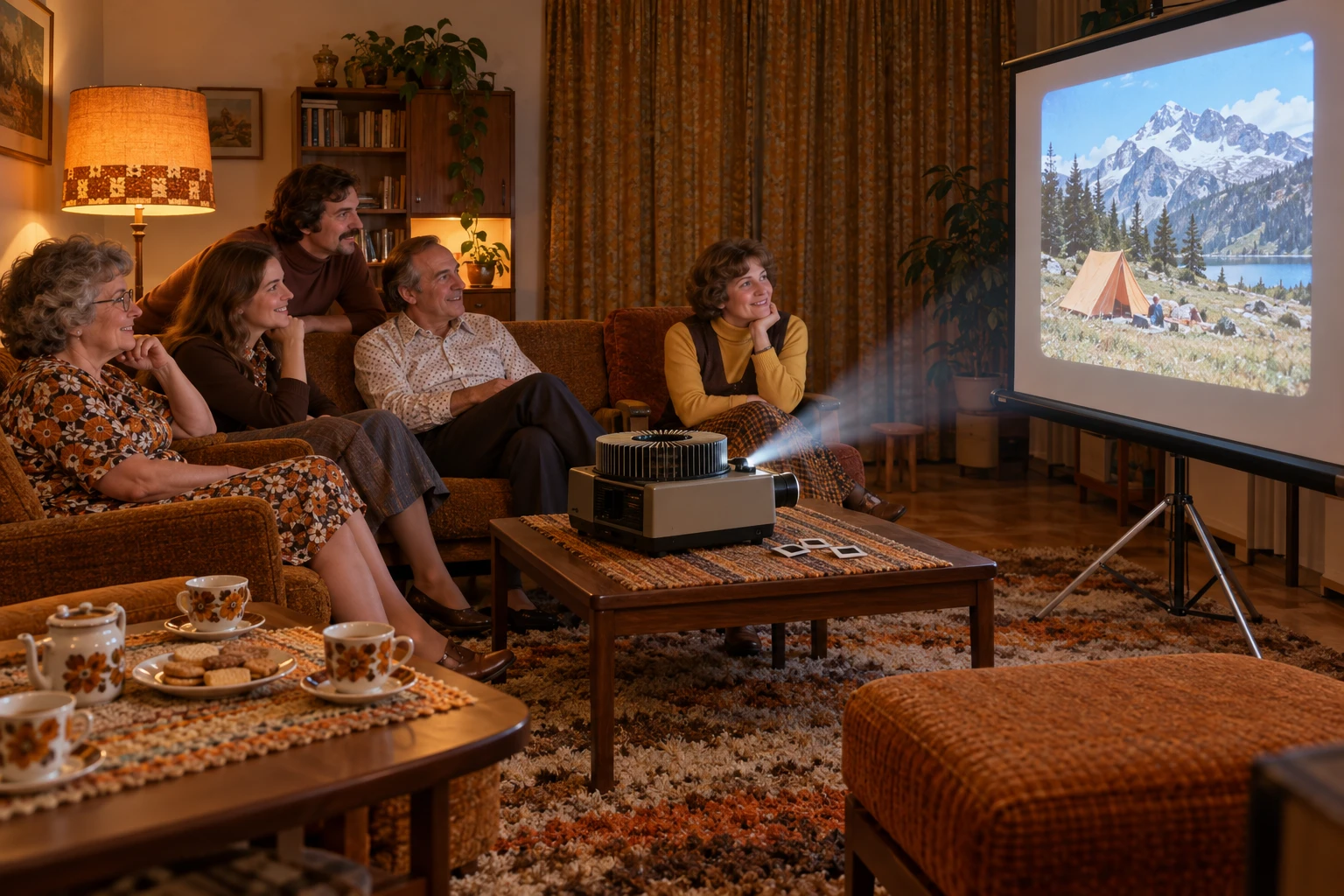
“That was outside our hotel.”
The slide evening had begun. In Dutch homes, as in many other countries, returning holidaymakers would invite relatives or friends to see their pictures. The guests watched with pleasure, or occasionally with a little resignation — especially when three more full slide trays were waiting beside the projector.
A photograph that light could pass through
A photographic slide was a small transparent image, usually held in a square cardboard or plastic mount. You took the photographs on slide film. Once developed, it produced a positive image: the colours and light and dark areas looked familiar when you held it up to the light. With a negative, you first needed a print to see the photograph in the usual way.
The projector shone light through the slide and enlarged the image through a lens onto the screen. A mountain landscape small enough to hold between finger and thumb suddenly filled a sizeable part of the living room. A well-exposed slide could show beautiful colours. Blue skies, red beach umbrellas and snowy peaks took on something of a festive glow.
For keen photographers, this was a major attraction. You could show your pictures on a large scale, to everyone at once.
The living room became a little cinema
First, though, there was some work to do. The projection screen came out of its cover. With a tripod screen, you unfolded the legs and pulled the screen upwards. A suitable white wall would do if you had no screen. The projector needed to stand at the right distance, and a power socket was not always conveniently close.
Then came the test image. Was the hotel leaning? Was the top of the picture wider than the bottom? Could someone turn off that lamp? And would somebody check that the curtains were completely closed?
Once everything was ready, the room changed. The furniture receded into the background. You could hear the projector's cooling fan and sometimes see dust floating through its beam. Anyone getting up for coffee risked casting an enormous shadow across the beach at Benidorm.
Click. Next one, please
How you advanced to the next slide depended on the machine. Simple projectors used a manually operated slide carrier. Others fed slides from a straight tray or a circular carousel. Kodak introduced its first Carousel projector in 1961, with a rotating slide tray.
A remote control allowed the storyteller to remain seated. Click: the campsite. Click: the children in the swimming pool. Click: the same children, now beside the pool. Another click: the pool without the children.
The controls also gave the presenter power over the pace. One photograph prompted a long story. Another disappeared before everyone had worked out what it showed.
“Wait, go back. Who's that standing next to Aunt Riet?”
The previous slide had to return, and a discussion began. About the neighbour's name, the year of the holiday, or who had had such a terrible headache that afternoon.
The host's holiday
Holidays provided plenty of material. The tent, the view from the balcony, the village market: back home, they enjoyed a second life. The photographer supplied the commentary missing from the pictures themselves.
“This was where we took the wrong turning.”
“It looks sunny, but an hour later it was pouring.”
“That man just wouldn't get out of the picture.”
For the travellers, every photograph held a memory. For the visitors, the connections were not always so clear. A sequence of mountain passes could start impressively and, after a while, begin to look like rather a lot more mountain passes.
This was how the slide evening acquired its slightly dubious reputation. “Would you like to come and see our holiday slides?” promised a sociable evening but left the running time open. And when the host said he had selected only the best pictures, you still glanced at the boxes waiting nearby.
Upside down and out of focus
The equipment provided interruptions of its own. A slide had been loaded the wrong way, and suddenly the whole family was upside down. Or the image was reversed, something you only noticed when the lettering on a shopfront looked wrong.
Sometimes a slide jammed. The projector clicked, but the picture stayed put. Someone switched on a lamp and the owner bent over the machine, while the guests returned their attention to the biscuits.
The photographs could disappoint, too. A blurred picture looked even blurrier on the big screen. A dark photograph prompted a debate about what it actually showed. A hair or speck of dust on a slide grew large enough to become a considerable distraction.
Those moments could be memorable in their own right. An upside-down uncle might get more laughter than a carefully photographed sunset.
Boxes of family history
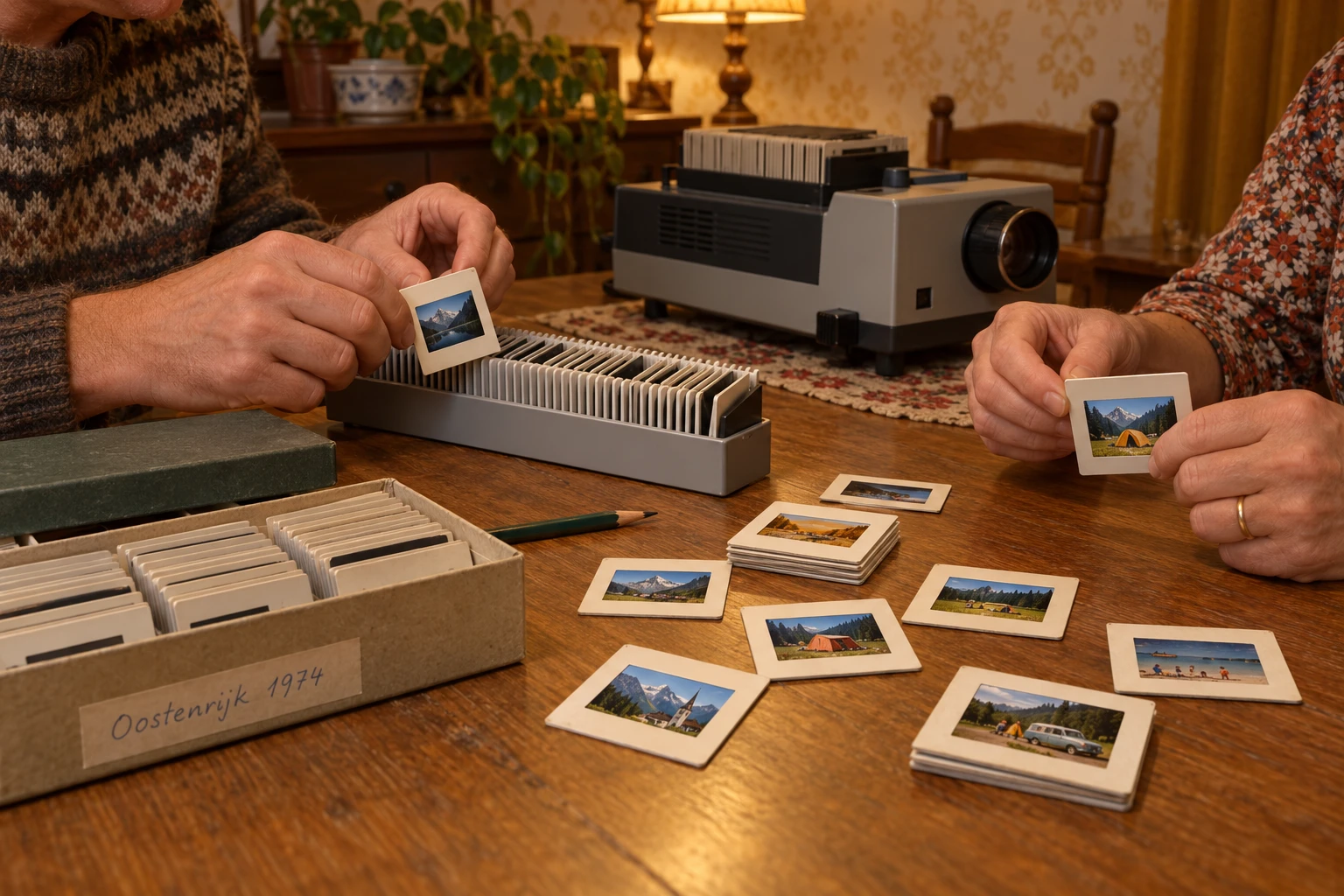
Afterwards, the slides went back into their boxes or trays. A label might read “Austria 1974” or “Summer + birthday”. Some mounts carried a handwritten date, place name or sequence number. These helped when the pictures were shown again later.
Between the holiday landscapes there was ordinary life as well. A child with a new bicycle. A birthday in the garden. A car outside the house. Looking again years later, your attention might turn to the background: the wallpaper, the chairs, the little shop on the corner that had since disappeared.
What had once been incidental became interesting with time. The people had grown older, or were no longer alive. The living room had been remodelled. Nobody remembered exactly where that small hotel had been.
Just one more tray
Digital photography made pictures easier to view and share. There was no film to develop, and a television or computer could display the images. In many homes, the projector retreated to a cupboard or attic. Slide photography still exists, however: slide film is still manufactured, and old collections can be scanned.
You can still gather to look at holiday photographs today. But a slide evening involved a whole preparation. Someone had arranged the pictures, set up the equipment and darkened the room. You settled down for the occasion.
After the final picture came that brief moment when the screen turned white again. The light went on. Everyone blinked. The living room returned.
“Well,” someone said, “you certainly had a lovely time.”
The host looked under the table.
“I've also got a tray from the journey home.”