The early digital years

Modems & the
acoustic coupler

Before the internet became a permanent connection, a computer literally had to call a telephone number. The receiver went into two rubber cups, and a strange conversation of beeps and hiss came down the line.

Read the story
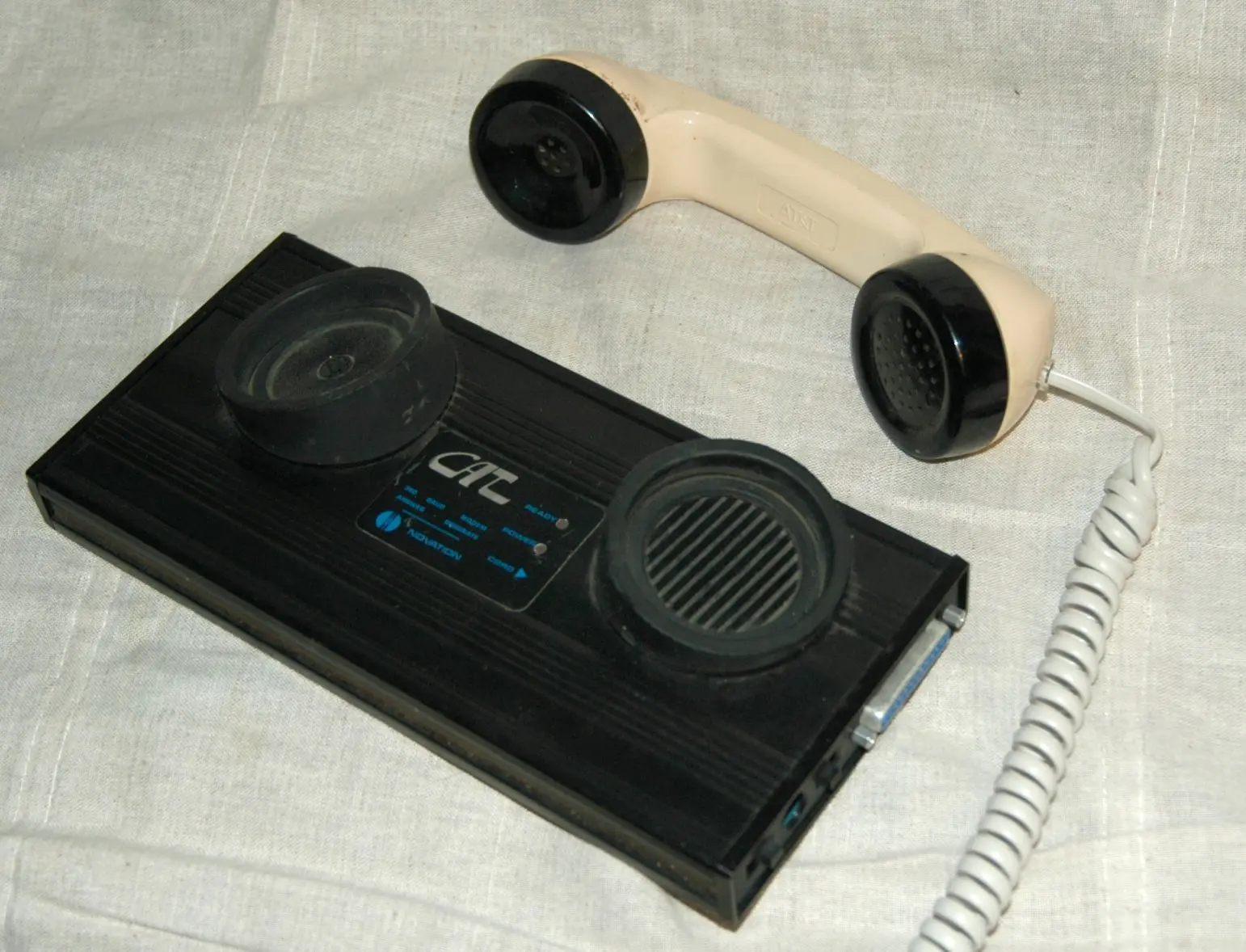
A telephone receiver rests in the rubber cups of an acoustic coupler
Acoustic coupler with telephone receiver. Photo: G. Edward Johnson, Wikimedia Commons · public domain.

From bits to sound

The modem made digital data suitable for a telephone network built for voices and other sounds.

When computers learned to telephone

A computer worked with ones and zeros, but a traditional telephone line understood only sound. A translator was needed.

The translator was called a modem

The name modem combines the words modulator and demodulator. The device converted digital information into tones that could travel down an ordinary telephone line. At the other end, a second modem translated the tones back into data a computer could understand.

To a person, it sounded like a strange electronic conversation. To the computers, the different pitches formed a stream of letters, numbers and commands.

The receiver in two rubber cups

An acoustic coupler connected nothing directly to the telephone line. The whole receiver rested in two rubber holders. One contained a small speaker that sent tones into the handset’s microphone. The other held a microphone that picked up sound from its earpiece.

In hindsight, this seems a cumbersome detour, but it had a major advantage. Telephones did not always have detachable plugs, and equipment connected to the network had to meet strict rules. The coupler used sound alone, changing neither telephone nor line.

How you connected

  1. 1
    Call the number

    Using the ordinary telephone, you dialled or keyed in the computer system’s number.

  2. 2
    Wait for the answering tone

    A high, continuous beep told you the modem at the other end was ready.

  3. 3
    Place the receiver

    You quickly pressed both ends into the rubber cups in the correct orientation.

  4. 4
    Stay online carefully

    A displaced receiver or loud noise in the room could cause interference or break the connection.

Even from a telephone box

Because no fixed connection was needed, you could carry the coupler with you. Journalists and other travellers could send text from a hotel room or, if the receiver fitted, a telephone box. It looked futuristic, but the technology was very tangible: without a good fit between rubber and receiver, nothing happened.

Reading as it arrived

300 bits per second

An early connection displayed around thirty characters a second. Short text was practical; sending a photograph barely was.

Online before the web

CONNECTED

WELCOME TO THE BULLETIN BOARD

> READ MESSAGES
> DOWNLOAD FILES
> SEND EMAIL_

The first online worlds were mainly text. Pictures took too much time and too many metered telephone units.

Reading at connection speed

On an early connection, you could almost read along as letters appeared on screen one by one.

Viditel and bulletin boards

From 1980, people in the Netherlands could discover Viditel, an early online information service from the PTT, the national postal and telephone service. Later, bulletin boards, usually shortened to BBS, grew in number. A bulletin board was a computer reachable through a telephone number.

Visitors read messages, exchanged small files, sent electronic mail or played a simple game. Usually, only one caller could connect at once. An engaged tone meant trying again later.

The modem starts making calls

Acoustic couplers gradually disappeared as modems connected directly to telephone lines. These machines were faster, more reliable and easier to use. You no longer needed to dial yourself and place the receiver at the right moment.

The Hayes Smartmodem became well known. It responded to text commands from the computer. With ATDTfollowed by a telephone number, the modem could make a call itself. Many other manufacturers adopted this method of control.

300bps
2,400bps
14,400bps
56ktheoretical maximum

Beeps, crackles and an engaged telephone

Anyone connecting to the internet in the 1990s recognised the sound immediately. First the modem dialled. Then came an answering tone, sharp beeps, rattles and hiss. During that electronic introduction, the modems agreed on a speed and transmission method.

While the connection was active, the telephone line usually could not carry an ordinary call. In many Dutch households, a familiar demand rang out: “Get off the internet, I need to use the phone!”

Cost mattered too. Internet sessions incurred normal telephone charges. Some users waited for off-peak rates or wrote messages offline first, avoiding wasted expensive minutes while connected.

From temporary contact to always online

Cable internet and ADSL changed everything around the turn of the millennium. A connection no longer needed rebuilding for each session. The internet became faster, stayed available and no longer occupied the telephone.

Waiting, engaged tones and the characteristic concert of beeps disappeared too. By then, the acoustic coupler was already a museum piece. Yet it represents an important transition: a computer, a telephone line and two rubber cups opened a new world.

Do you remember…?

…thinking you could hear from a modem’s sound whether the connection would succeed? And a one-megabyte file being quite a substantial download?

More calls & messages

Calling while out once meant finding coins and stepping into a glass telephone box.

Read about the telephone box