
“Look it up”
How high is Mount Everest? Who was Napoleon? And what is the difference between a crocodile and an alligator? Before you typed questions like these into a search engine, the answer might be a few metres away. On a bookshelf, behind a heavy cover.
“Look it up in the encyclopedia,” a parent would say. That meant getting up, choosing the right volume and turning pages. First you checked the letters on the spine. Then you flicked through the pages, following the guide words at the top. Once you reached your subject, the reading began.
Sometimes you found what you needed straight away. Sometimes there was only a short explanation and a reference to another entry. The first book went back and a second appeared on the table. Searching was something you did with your hands.
An impressive row
Not every household had an encyclopedia. A large set cost money and took up considerable space. There were also smaller editions in one or a few volumes. If you could not find what you needed at home, you could try the library or a school collection.
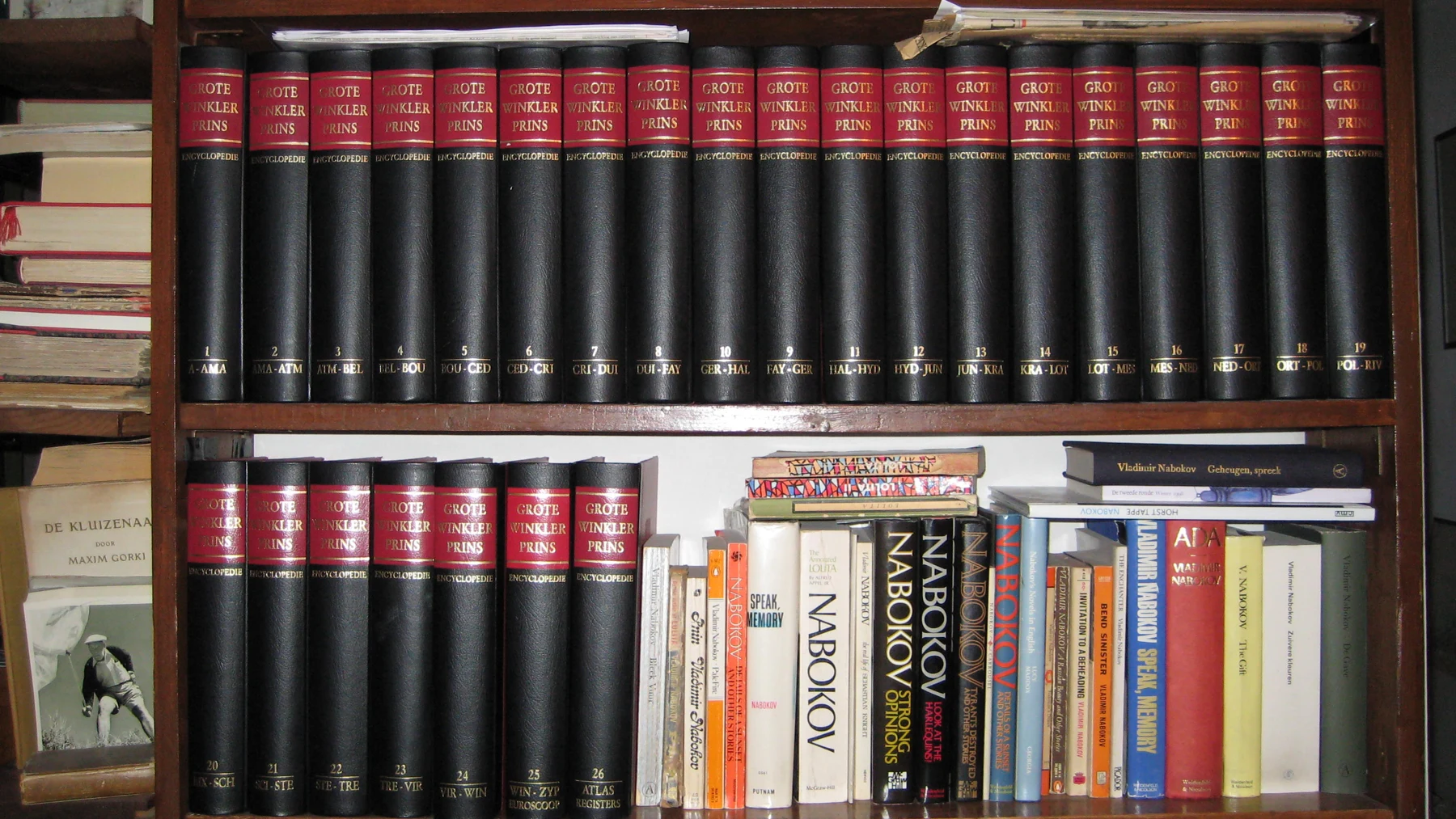
In the Netherlands, Winkler Prins was a familiar name. Its first edition appeared between 1870 and 1882 and comprised sixteen volumes. Generations later, that name still appeared on the spines of reference books in Dutch homes. Other names included Oosthoek and the Grote Nederlandse Larousse.1
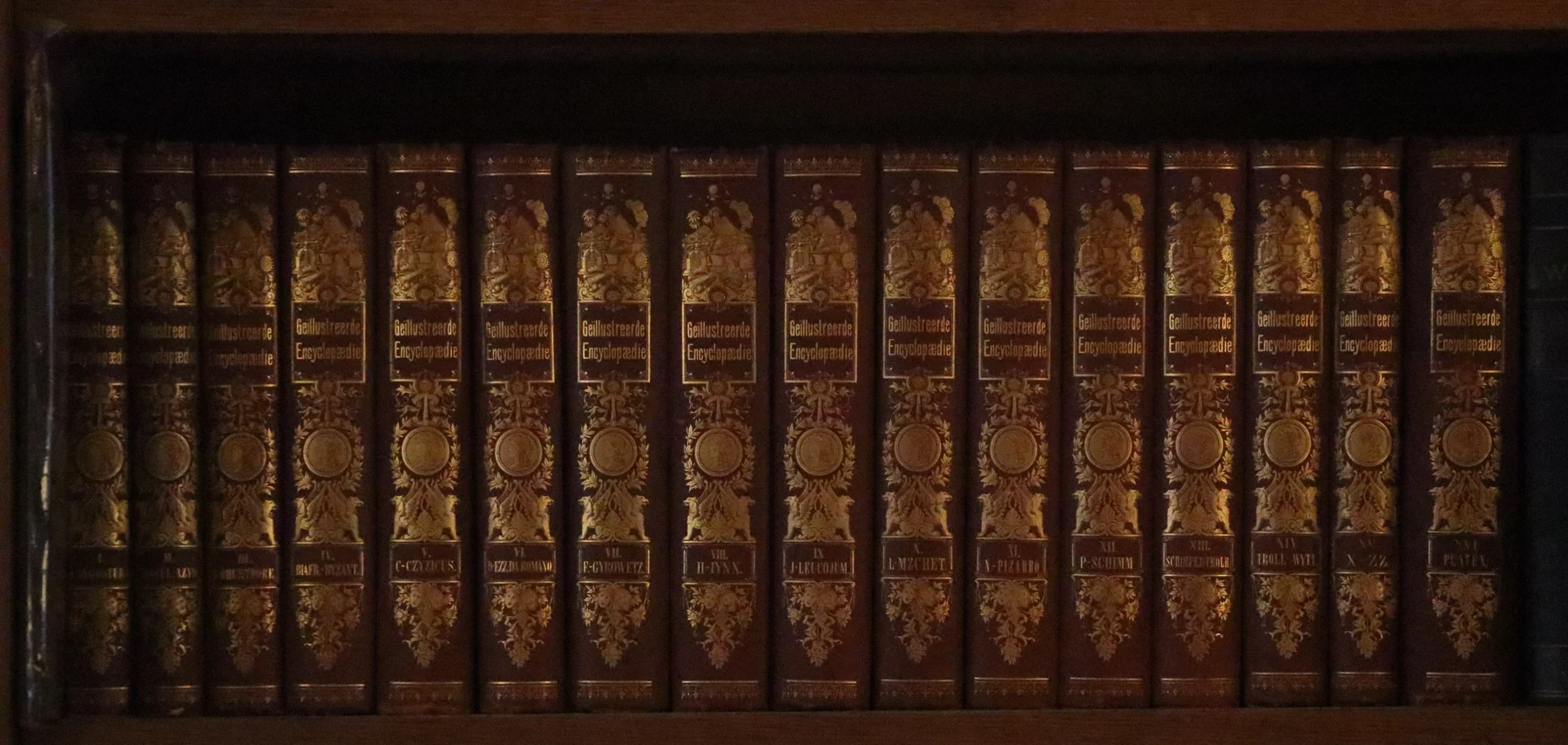
Such a set was useful, but it could also make an impression. Matching bindings, carefully designed spines, sometimes gold lettering: an encyclopedia gave a bookcase weight. Literally, but also as a sign that knowledge mattered in that home.
For parents, buying one could be an investment in their children’s future. When school brought questions, the answers would already be waiting.

A school project began with the right letter
For a classroom talk about volcanoes or a project on ancient Egypt, the encyclopedia was a natural starting point. It supplied an overview, a few dates and words to guide further research.
You did, however, have to know which entry to look for. An encyclopedia did not understand a complete question. If you wanted to know why the ground shook, you would look under “earthquake”, for example. An index could help when something was not where you expected it to be.
Then came the task of putting the explanation into your own words. The text was not always written for children. Sentences could be complicated; unfamiliar terms sent you off on another search. With a notebook beside the open volume, you tried to turn it into an understandable story.
And copying existed long before the internet. An elegantly phrased paragraph in a child’s project might look remarkably like the entry in the encyclopedia.
You looked up an animal and ended up in antiquity
You did not have to read an encyclopedia from beginning to end. Yet it was tempting to keep turning the pages once you had found your answer.
Beside your subject was something you had never heard of. A vanished civilisation. An unusual musical instrument. An animal with an improbable name. A portrait of somebody gazing solemnly out at the world.
Alphabetical order brought together subjects with little connection to one another. That was precisely why you could end up somewhere unexpected. You began with a specific question and finished with a subject you had never thought to ask about.
It also made the encyclopedia a pleasant way to spend a spare half-hour. All you needed was a random volume from the shelf.
The world in cross-section
The pictures deserved attention of their own. Not every edition was equally well illustrated, but maps, drawings and photographic plates could bring a volume to life.
A cross-section of the human body. The layers of the Earth. A diagram of an engine. Flags and maps. When the words became difficult, a picture sometimes gave you something to work with.
You could linger over a page like that. Your finger followed a river or searched for a place name on a densely printed map. You looked at the image at your own pace; there was no next video starting automatically.

If it was in the book, it must be true
An encyclopedia carried authority. Its entries had been compiled and edited, and its careful presentation helped inspire confidence. If something appeared in it, you had a substantial argument in a discussion at the dinner table.
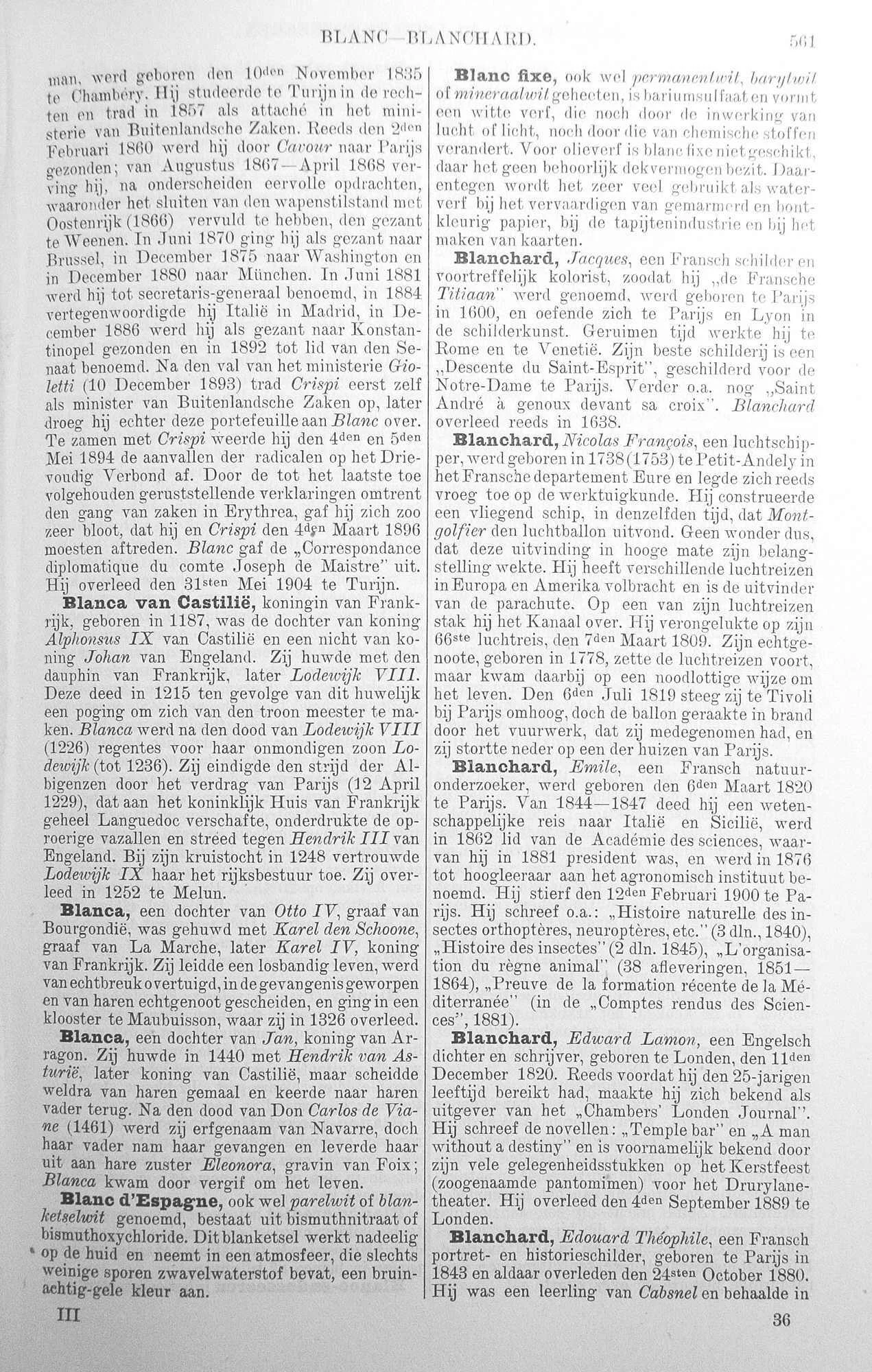
Yet encyclopedias were made by people. Editors decided which subjects deserved space and from which perspective to describe them. Older editions reveal, for example, how their time discussed colonies, other cultures or the roles of women and men.
An old encyclopedia therefore tells us about the past in two ways. Through the events it describes, and through the way it explains those events.
The books grew older; the world moved on
Time was the great difficulty. Once a printed encyclopedia had been published, it could not simply be updated.
Countries changed their names. Borders shifted. Scientists made discoveries. People who were still alive in the book died. For an explanation of a plant’s structure, that might not matter much. For population figures, political leaders or recent technology, it did.
Some publishers offered supplements or yearbooks. These added to the original set, but also made looking things up more complicated. You had to consider whether your answer might be in a later volume.
Buying a completely new encyclopedia was a bigger decision. A family might therefore use the same books for years. The world changed, while the same countries and dates remained on the shelf.
First a disc, then the internet
In the 1990s, the row of books faced competition from the CD-ROM. Microsoft’s Encarta appeared in 1993. Digital encyclopedias offered search functions and could combine text with sound and moving images.
The difference was substantial. You no longer had to select the right volume and could easily click from one subject to another. Information that had once needed an entire shelf fitted on a disc.
The internet then made the change more profound. Information became accessible without first buying a complete set of reference books. Websites could also be updated without printing a new edition.
A notable moment came in 2012, when Encyclopaedia Britannica announced that it would stop producing its printed encyclopedia. The 32-volume edition of 2010 was its last on paper. The reference work continued digitally.
The bookcase remained
The familiar encyclopedia lost its central role as the first place to turn with a question. When moving house, a complete set became something to think about: do we still use these books, and where will they go?2
But an old encyclopedia is not automatically worthless. You can read it, study its pictures and discover which knowledge was once considered essential. Current facts need caution; as a record of its time, a set can be fascinating.
The experience of using it remains familiar too. The weight of a volume on your lap. The soft rustle of thin paper. The book left open on the table because somebody wanted to check something later.
The printed encyclopedia gave knowledge a visible place in the home. You could point to where the answers lived, even though they were far from all being there.3
And sometimes the best answer was the one you had never been looking for.