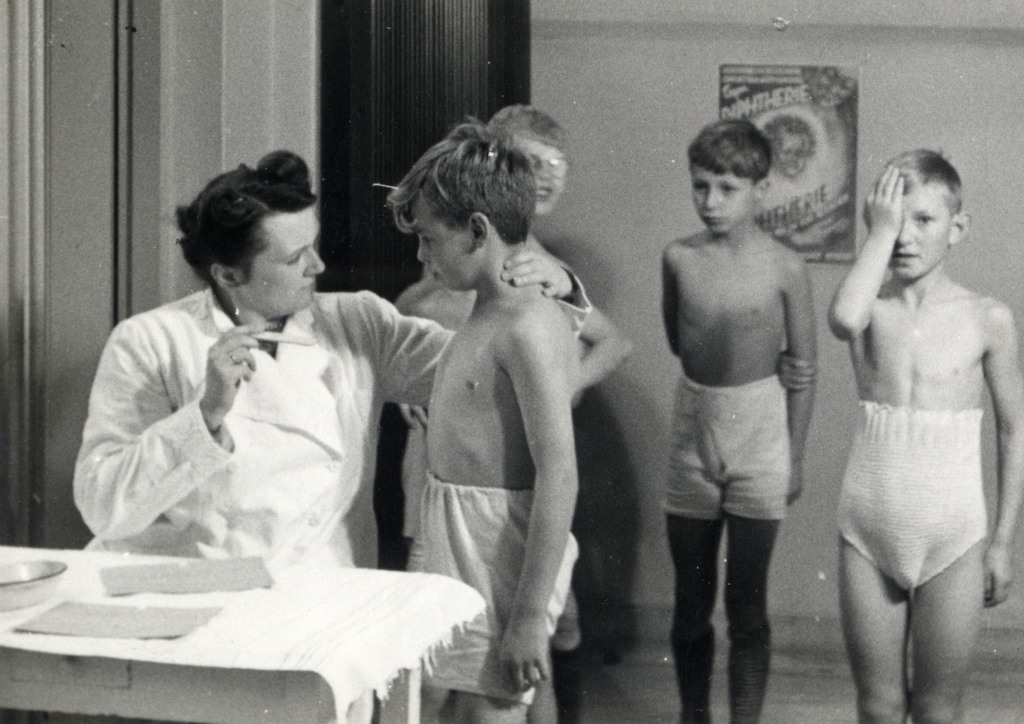
In the Netherlands, you visited the school doctor even when nothing was wrong. That made him — or her — different from your family doctor. You were not ill or in pain, yet someone needed to check your eyes, measure your height or examine your back. For many children, it was a strange interruption: no arithmetic for a moment, but an examination whose purpose you did not always understand.
The visit differed by school, place and period. Yet the same elements recur in memories: the eye test, the scales and waiting your turn.
A doctor for healthy children
At the start of the twentieth century, a doctor examining healthy schoolchildren was still something new. In 1904, Zaandam became the first Dutch municipality to appoint a school doctor. Others followed. The idea was to discover health problems early, before they seriously affected a child at school or home.
School offered a useful point of contact. It brought together children growing up in very different home circumstances. Not every family immediately saw a doctor when poor sight or hearing was suspected.
The school doctor’s arrival also gave doctors more influence over children’s everyday lives. Health became something schools helped monitor.
What did that chart say?
For a child, an eye test could easily feel like a classroom test. Cover one eye and say what you saw on the chart. At first it was easy. Lower down, it became harder. Was that this letter, or another?
It was not about a good mark, of course. The test aimed to establish whether a child could see well enough. A pupil struggling with the blackboard need not be inattentive: perhaps the letters were simply blurred.
Hearing received attention too. An Amsterdam report from 1922 describes an examination using a whispered voice and a picture-based eye test.
Measuring, weighing and checking your back
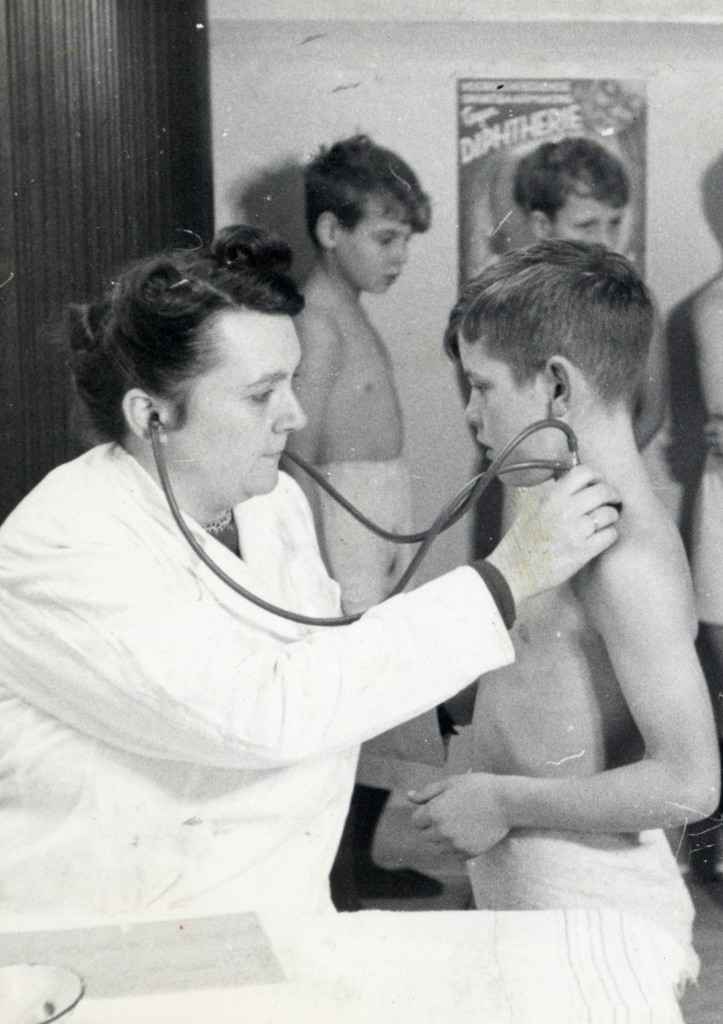
Height and weight were straightforward measurements: you could record and compare them later. Posture mattered too. Backs and feet were among the body parts school doctors examined.
A former Amsterdam school doctor recalled her daughter standing undressed in a line with other girls for examination. Privacy practices could differ greatly from what children are used to today.
That makes looking back complicated. An examination could be useful and uncomfortable at the same time. A doctor saw posture needing attention; a child mainly felt that others were looking at their body.
Behind the figures was a family
In the early years, malnutrition and hygiene were major concerns. The Onderwijsgeschiedenis educational history website describes school doctors frequently identifying malnutrition in children.
Nurses assisted and sometimes visited homes. Their work against head lice also earned them the nickname ‘lice nurses’.
For families, this involvement sometimes meant help, but could also feel like scrutiny. Judgements about a child’s care quickly touched on the household and parents.
Attention to how you were doing too
After the Second World War, more attention went to the psychological and social sides of health. Establishing that a child saw well and grew enough did not tell the whole story.
School doctors consequently gained a broader role, including problems at home and school.
To pupils, they remained adults in an unusual position: neither the teacher you saw daily nor your own family doctor, but someone who occasionally asked how you were doing.
The school doctor is still here
School doctors belong to memories of the past, but their work has not vanished. In the Netherlands today, the usual terms are youth health doctors and nurses within preventive child health services. Medical assistants also conduct parts of examinations.
Practices differ by region. In Amsterdam, primary-school children are invited for health examinations at five and ten, for example. These include measuring and weighing and, depending on age and circumstances, sight and hearing checks. Clothes remain on, and participation is voluntary.
Well-being and development receive attention too. Behind the familiar eye test lies the same idea: a child need not be clearly ill before someone asks whether all is well.
A brief interruption that stayed with you
The school doctor appeared only occasionally. Yet a visit could remain in memory for years: the bottom line you could no longer read, the tension before entering or the relief when it was over.
For some, it remained a routine check. For others, it led to further examination. Sometimes something visibly changed: on your next classroom visit, you suddenly had glasses on your nose.