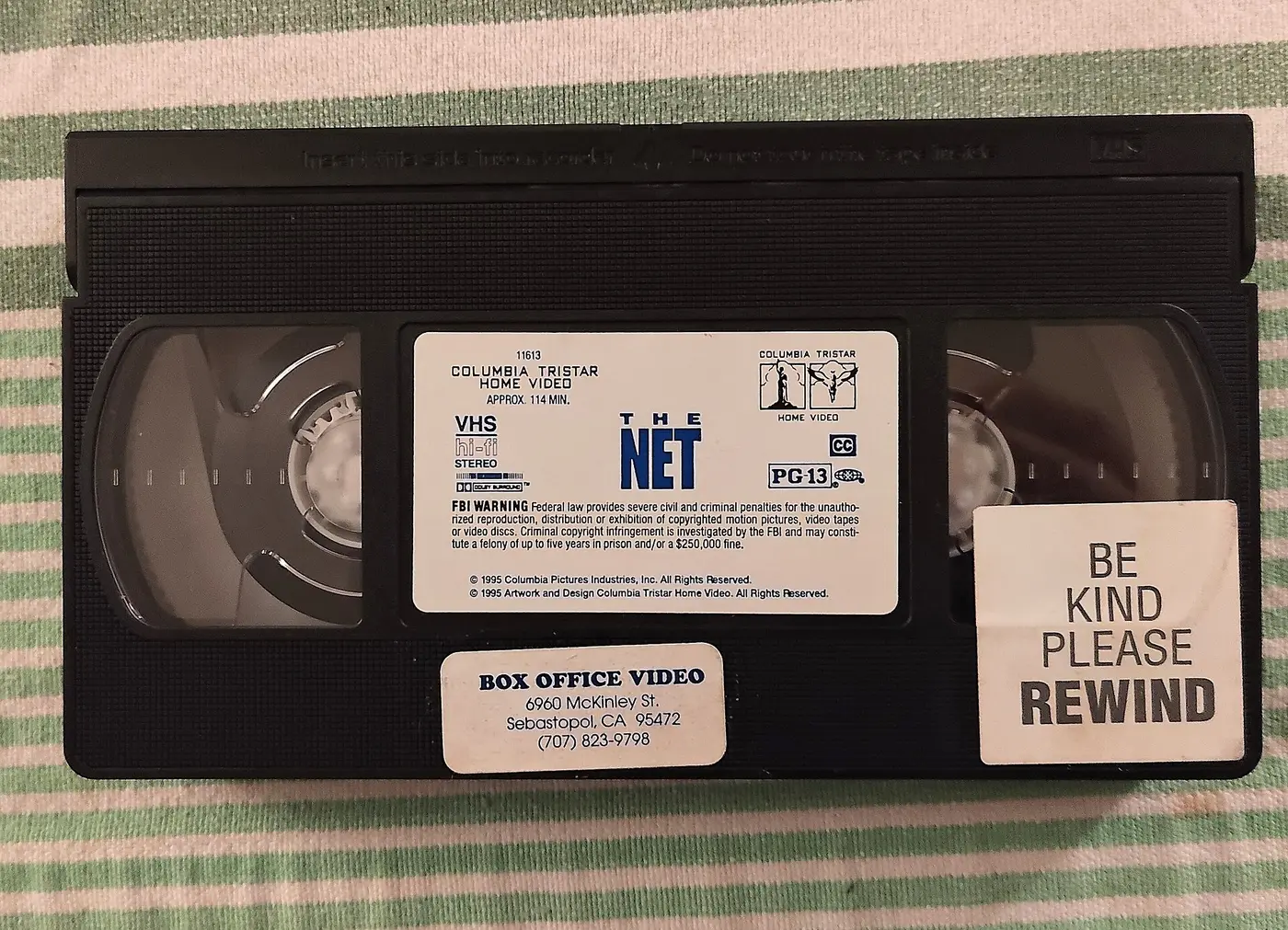

Somewhere beneath the television stood a substantial machine with a clock display. Beside it lay tapes with handwritten labels. One contained a film, another a few episodes of a series. Sometimes a title had been crossed out and replaced. What was on the tape did not always match the label.
The video recorder brought a little freedom into the living room. You no longer had to stay in for every broadcast. It also brought new worries. Was there enough space on the tape? Was the timer set correctly? And had somebody erased your recording?
Television acquired a memory
Before the video recorder, missing a programme meant hoping for a repeat. The broadcaster decided when you watched. A film broadcast on Friday evening required a free Friday evening.
With a recorder, you could keep a broadcast. That sounds obvious now, but it changed the relationship between viewers and television. You could go out while the machine recorded a film at home. Or record a programme while watching another channel, because the recorder had its own television tuner.
It did not always work. A broadcast running late could leave you without the end of a recording. Setting the wrong channel meant finding a completely different programme the following day. And a flashing clock after a power cut was rarely reassuring.
Three systems, three kinds of tape
Sony introduced Betamax in 1975. JVC followed in 1976 with VHS, short for Video Home System. In 1979 Philips and Grundig added Video 2000. These dates mark the systems’ introductions; availability varied by country. [1][2][3]
They were not three brand names for the same product. They were different recording systems with their own cassettes. A Betamax tape would not play in a VHS recorder, nor would a Video 2000 cassette. Once you had bought a machine and built up a collection of tapes, you were fairly committed to your choice.
| System | Developer(s) | Introduced | Distinctive feature |
|---|---|---|---|
| Betamax | Sony | 1975 | Smaller cassette than VHS |
| VHS | JVC | 1976 | Became the dominant standard |
| Video 2000 | Philips and Grundig | 1979 | A cassette you could turn over |
In the shop, the decision involved more than price or appearance. Which system did friends and relatives have? Could you swap tapes? And which films did the local rental shop stock for your machine?
Betamax: a good reputation was not enough
Betamax arrived early and acquired a reputation for good picture quality. Its cassette was smaller than VHS. For people who enjoyed comparing equipment, it was a serious contender.
The first version did have a limitation: when introduced in Japan and the United States, it could record about one hour per cassette. The first VHS system offered two hours. That difference mattered if you wanted to record a complete feature film. [2]
Betamax later offered longer recording times. Saying that a Betamax tape could only ever hold one hour is therefore incorrect. European versions and later tapes also offered different playing times.
The claim that ‘Betamax was better, but lost’ oversimplifies the story too. Picture quality depended on the machine, the tape and the recording mode. A format could have an advantage in one technical respect while buyers mainly wanted to know whether a film would fit and whether enough rental titles were available. [4]
A recorder was bought to be used, after all, not just to have its specifications admired.


VHS: the system you saw everywhere
VHS became the standard. Many manufacturers sold VHS recorders. During development, JVC had considered affordable production, ease of use and compatibility between different brands’ machines. That broad support helped the system gain ground. [2]
At home, this eventually meant that taking a tape to somebody else’s house became easier. In rental shops, VHS became the obvious choice. A larger audience made releasing films on VHS more attractive; a larger film catalogue made buying a VHS machine more attractive in turn.
The choice reinforced itself. You did not need a strong preference for the format. If the people around you used VHS and the rental shop was full of it, the decision was almost made for you.
The large rectangular cassette became a familiar object. You took it out of a cardboard sleeve or plastic case, slid it into the recorder and heard the mechanism draw the tape inside. After a moment of noise, a logo or a warning, the film could begin.
Video 2000: the tape you could turn over
For Dutch households, Video 2000 had a familiar name behind it: Philips. Together with Grundig, the company developed a system with a particularly useful feature. You could turn the cassette over, just like an audio cassette.
A suitable tape offered four hours on each side: eight hours in total, with a turn in between. For each side, the recorder used half the tape’s width. Many models also had an advanced system that allowed the video heads to follow recorded tracks precisely, helping with stable still pictures and special playback functions. [4]
It sounded like a convincing alternative. But Video 2000 arrived later than its main competitors. Technically ambitious and relatively expensive, it had to compete against an established lead. [4]
For owners, that was not an abstract problem. A good recorder remained a good recorder, but a limited selection of suitable rental films became apparent on every visit to the video shop.

.jpg)


‘Have you got it for our machine?’
At the rental shop, choosing a film was only part of the task. You also needed the right version. An appealing case was little use if the cassette did not fit your recorder.
Especially while several systems coexisted, asking about the format was part of hiring a film. Did the shop have it on Betamax? Was there a Video 2000 version? Or was VHS the only copy on the shelf?
The same problem arose when lending a television recording. Somebody might have carefully recorded a programme for you, but if your machines used different systems, you could not watch it at home.
The format war therefore played out between neighbours, friends and relatives as well. Asking ‘which video have you got?’ was about whether two households could share something.
Do not record over this tape
Whatever the system, each household developed its own way of managing tapes. Some could be recorded over repeatedly, others held children’s programmes, and some recordings absolutely had to be kept.
‘DO NOT ERASE’ might appear in large letters on a label. With VHS, you could also break off the recording protection tab to prevent accidental recording. If you later wanted to reuse the tape, you could cover the hole again.
Keeping track was difficult. A film might occupy the beginning of a tape, a music programme the middle and part of another recording the end. Fast-forwarding became a search through flashing pictures.
Anyone wanting to start recording at precisely the right moment sat ready with a finger on the button. Missing the beginning was annoying. Starting too early meant also recording the continuity announcer, an advertisement or the end of the previous programme.
Those unintended fragments make old recordings interesting now. A home-recorded tape often preserves more of its period than just the programme somebody wanted to keep.
Rewinding was part of the experience
A videotape required patience. After a film, you had to rewind it. Finding a particular scene meant fast-forwarding, stopping, checking and sometimes going back a little.
Picture quality had its quirks too. Interference lines could cross the screen. You tried to improve playback with the tracking control. A worn tape or dirty video heads could spoil a film evening.
Occasionally things went badly wrong and a cassette came out with a loop of crumpled tape. Television had become surprisingly tangible: a recording consisted of metres of thin magnetic tape that had to pass through a mechanism.
What remained in the cupboard
VHS won the battle for the living room. Later, it too faced competition from DVD and other ways of recording and watching films. The recorder gradually disappeared from its place beneath the television.
The tapes often stayed longer. Cupboards and attics still hold recordings of holidays, birthdays and television evenings. On the spine is a title somebody wrote with a ballpoint pen decades ago.
VHS, Betamax and Video 2000 were competing systems, but they offered the same new possibility: deciding for yourself what to keep and when to watch it again.
Perhaps you no longer remember your recorder’s model number. But you probably remember the sound it made as it took in a cassette. And the suspense of pressing ‘play’ to discover whether the recording had worked.